
The Mud Lotus Model: A Cultural–Relational Framework for Trauma, Identity, and Risk Assessment with Japanese Clients
This paper proposes the Mud Lotus Model, a cultural–relational framework for understanding trauma, identity, and suicide risk among Japanese clients. Conventional trauma and risk assessment approaches are largely based on Western individualistic models, which may not adequately capture relational and cultural dimensions of distress.
Drawing on cultural psychology, sociology of identity, Japanese philosophy, and meaning-making theory, this paper argues that trauma can be understood not only as a psychological injury but also as a disruption to identity, relational belonging, and meaning systems. The model integrates key cultural concepts such as haji (shame), aidagara (relational existence), kazoku (family), and ikigai (life meaning), as well as indirect communication styles common in Japanese contexts.
The Mud Lotus Model introduces the concept of relational risk, suggesting that risk and protective factors may exist within relationships, cultural expectations, and social contexts, rather than solely within the individual. The model is proposed as a conceptual framework for culturally informed trauma counselling and risk assessment in cross-cultural and sensitive claim contexts.
Author Keywords: Cultural psychology; trauma; institutional trauma; suicide risk assessment; relational risk; Japanese culture; narrative identity; meaning-making; cross-cultural counselling; cultural safety; identity reconstruction; Mud Lotus Model
Introduction
In Western counselling psychology, trauma and suicide risk are typically assessed at the individual level, focusing on personal distress, mental health symptoms, and individual coping capacity. These approaches are based on an implicit cultural assumption of the independent self.
However, cultural psychology research suggests that the Japanese sense of self is often interdependent and relational rather than independent and individual (Markus & Kitayama, 1991). The Japanese philosopher Watsuji described human existence as aidagara, meaning that human beings exist fundamentally in relationships, not as isolated individuals (Watsuji, 1996). This relational understanding of self has significant implications for trauma counselling and risk assessment. This paper argues that trauma and suicide risk among Japanese clients cannot be fully understood without considering cultural concepts such as haji, family responsibility, social role, language, and life meaning.
This paper is situated within interdisciplinary research across cultural psychology, sociology of identity, trauma studies, and cross-cultural counselling. It draws on theories of interdependent self (Markus & Kitayama, 1991), relational identity and aidagara (Watsuji, 1996), shame as a social emotion (Lebra, 1983; Farese, 2016), meaning-making and narrative identity (Park, 2010; McAdams, 2001), and research on suicide and relational distress in Japan (Ozawa-de Silva, 2008). By integrating these perspectives, this paper proposes the Mud Lotus Model as a cultural–relational framework for understanding trauma and risk among Japanese clients.
This paper draws on interdisciplinary literature including cultural psychology, sociology of identity, Japanese philosophy, linguistic anthropology, meaning-making theory, and cross-cultural counselling. It also incorporates the concepts of high-context communication (Hall, 1976), cultural humility (Hook et al., 2013), and cultural safety (Ramsden, 2002) to propose a culturally informed framework for trauma counselling and risk assessment with Japanese clients.
Shame, Family, and Social Identity
Western psychological models are largely based on an individualistic model of the self, whereas Japanese cultural contexts often reflect a relational model of the self, where identity is embedded in social relationships, roles, and responsibilities (Markus & Kitayama, 1991; Watsuji, 1996).
The concept of haji in Japan is strongly connected to social relationships and family reputation rather than only individual self-evaluation (Lebra, 1983; Farese, 2016). Japanese individuals are often socialised to be aware of how their behaviour affects the family and social group, and to avoid bringing shame to the family name (Stanford University School of Medicine, n.d.).
Anthropological research has also documented how illness, trauma, and social problems in Japan may be experienced as threats to family and social identity, not only as individual problems (Ohnuki-Tierney, 1984). This relational understanding of identity means that traumatic events may be experienced as a family and social crisis rather than solely an individual psychological event.
Relational Risk and Family Context
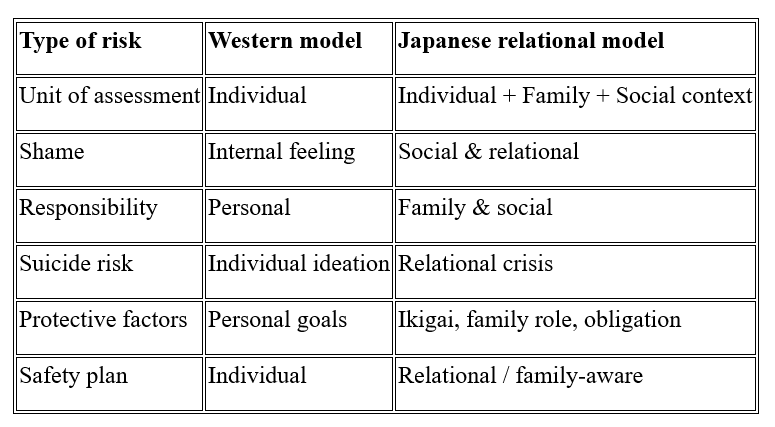
Research on suicide in Japan has shown that social isolation, shame, and relational disconnection are significant factors in suicide risk (Ozawa-de Silva, 2008). In addition, family responsibility and social role may function as both stress factors and protective factors.
In my previous work at a government agency in Osaka, Japan, suicide risk assessments were conducted not only for individual victims but sometimes also for family members, particularly in cases involving significant social shame or family crisis. This reflects a relational understanding of risk, in which distress and suicide risk may exist within the family system rather than solely within the individual.
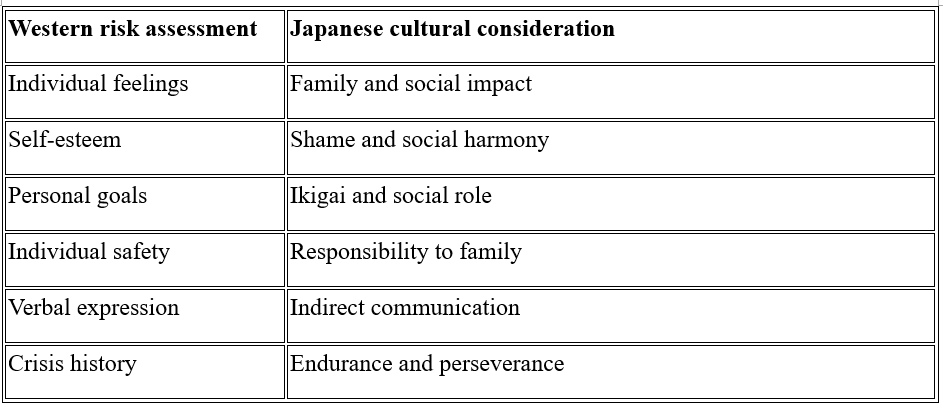
Therefore, risk assessment for Japanese clients should include:
Family relationships
Perceived shame
Social isolation
Family expectations
Social role and responsibility
This approach can be described as relational risk assessment.
Table 1
Comparison Between Western Risk Assessment and Japanese Cultural Considerations
A Japanese client may appear:
Calm
Not expressive
Saying “I’m okay”
Not reporting suicidal thoughts
This does not automatically mean low distress.
At the same time, strong family connection, ikigai, and cultural beliefs about responsibility can function as protective factors.
Therefore, risk assessment with Japanese clients should be culturally informed, not based only on Western individualistic models.
Language, Indirect Communication, and “Reading the Air”
Language plays a central role in how distress is expressed. Many Japanese emotional concepts cannot be directly translated into English, including haji, gaman (endurance), shoganai (restraint), ikigai, enryo (restraint), kuuki (social atmosphere), and funiki (emotional tone). These words represent cultural frameworks for understanding emotion, endurance, responsibility, and social harmony.
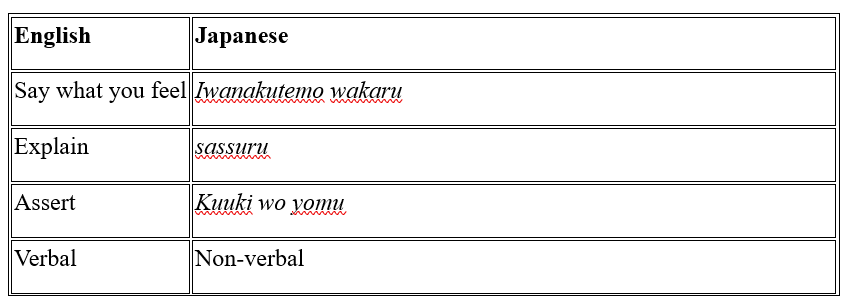
Japan is often described as a high-context culture, where communication relies on shared understanding, context, silence, and non-verbal cues rather than direct verbal expression (Hall, 1976). In high-context cultures, meaning is often communicated indirectly and is embedded in social relationships, atmosphere, and situational context rather than explicit words. This has important implications for counselling and risk assessment, as distress may not be expressed through direct statements such as “I am depressed” or “I am suicidal,” but may instead be communicated through silence, hesitation, apologies, or changes in atmosphere.
Therefore, therapists working with Japanese clients must pay attention not only to verbal content but also to atmosphere, silence, and indirect communication — what in Japanese may be described as “reading the air” (kuuki o yomu).
Trauma therapy requires:
Emotional nuance
Cultural meaning
Trust
Safety
Ability to explain shame, responsibility, and family dynamics
These concepts are culturally embedded and often cannot be translated directly into English without losing important meaning.
For Japanese clients, being able to speak in Japanese with a therapist who understands concepts such as haji, kazoku, gaman, and ikigai can be critical for:
Engagement in therapy
Accurate risk assessment
Emotional safety
Effective trauma processing
This is why cultural matching is not just a preference — it is often a clinical need.
Table 2
Examples of indirect expressions that may indicate distress in Japanese clients
In Japanese communication, therapists must pay attention not only to what is said, but what is not said. The concepts of kuuki and funiki are important in understanding a client’s emotional state. Japanese clients often communicate distress indirectly, through silence, hesitation, vague expressions, or changes in atmosphere rather than clear verbal statements.
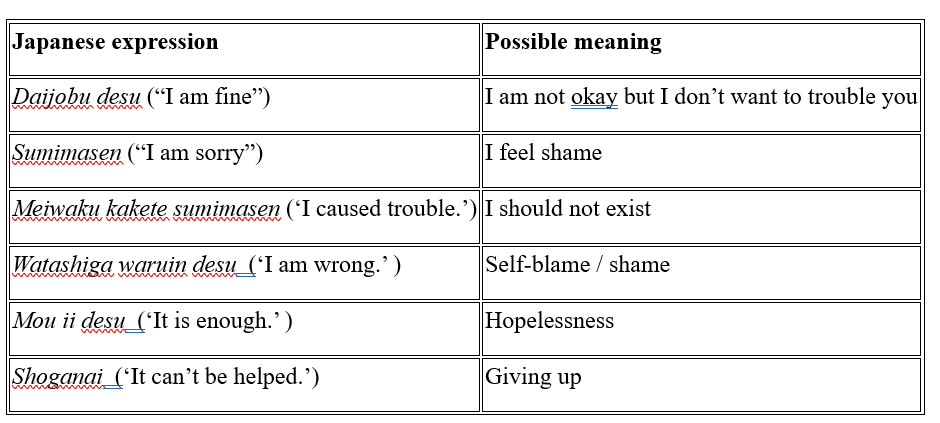
Japanese clients may express distress using indirect language such as “I’m sorry,” “I caused trouble,” “It can’t be helped,” or “I’m okay.” These expressions may reflect shame, hopelessness, or self-blame rather than actual wellbeing. Therefore, risk assessment with Japanese clients requires understanding indirect language and cultural communication styles.
Table 3
Examples of risk-related language that may be misunderstood by non-Japanese therapists
When working with Japanese clients, therapists may need to communicate in a less direct way, use silence therapeutically, and avoid overly confrontational or highly verbal approaches. Building trust may involve shared understanding, empathy, and sensitivity to what is happening in the space between therapist and client, not only what is being spoken.
Theoretical Framework: Identity, Meaning-Making, and Relational Self
Trauma does not only affect psychological functioning but also identity, meaning, and social relationships. From this perspective, trauma can be understood not only as a psychological injury but also as a disruption to identity, social belonging, and meaning systems. Identity theory suggests that identity is formed through the interaction between individual agency and social structure (Côté & Levine, 2002). The looking-glass self theory further suggests that individuals develop their identity through how they believe others perceive them (Cooley, 1902). Trauma, particularly interpersonal violence and institutional trauma, can damage not only psychological wellbeing but also social identity and personal meaning.
Meaning-making theory suggests that individuals cope with traumatic experiences by integrating them into a broader meaning system and life narrative (Park, 2010; McAdams, 2001). However, some scholars have criticised post-traumatic growth models for placing pressure on survivors to frame trauma positively and for ignoring structural and institutional injustice (Tseris, 2013). Instead, trauma recovery may involve meaning integration and identity reconstruction rather than growth.
The Mud Lotus Model is positioned within this meaning-making and identity framework, but extends it by incorporating cultural and relational concepts from Japanese cultural psychology and philosophy. The model proposes that trauma recovery involves not only psychological recovery but also identity maintenance, relational safety, and meaning reconstruction within cultural and social contexts.
Ikigai as a Relational Protective Factor
The concept of ikigai, or a sense that life is worth living, has been shown to be associated with lower mortality and better mental health in Japan (Sone et al., 2008). Ikigai often includes family roles, social responsibilities, and contributing to others, which reflects the relational nature of meaning in Japanese culture.
In risk assessment, ikigai can function as a protective factor, particularly when it is connected to family, responsibility, and future roles.
The Mud Lotus Model (Cultural–Relational Model)
The Mud Lotus Model is an integrative cultural–relational meaning-making framework that conceptualises trauma as a disruption to identity, meaning, and relational existence rather than only a psychological disorder. The model proposes that recovery involves meaning integration, identity maintenance, and relational safety, and that suicide risk should be understood within relational and cultural contexts, not only at the individual level.
Figure 1
The Mud Lotus Model: A Cultural–Relational Framework for Trauma, Identity, and Risk Assessment
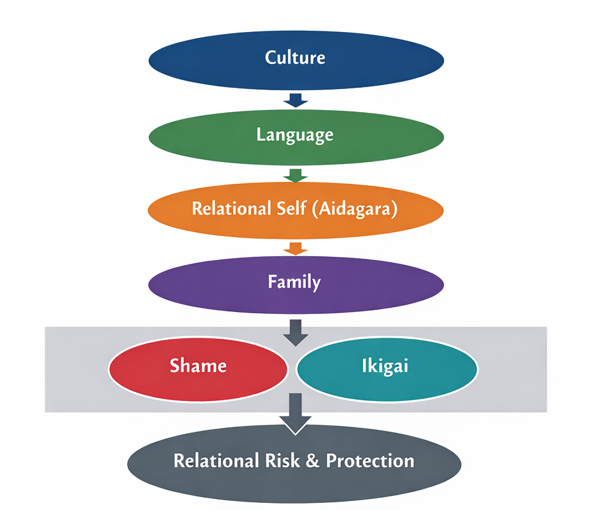
Note. The Mud Lotus Model illustrates how culture, language, aidagara, and family context interact to shape experiences of haji, ikigai, and relational risk. The model proposes that trauma is a disruption to identity, meaning, and relational existence, and that risk and protective factors are located not only within the individual but also within relational, cultural, and social contexts.
Table 4
Explanation of the Mud Lotus Model
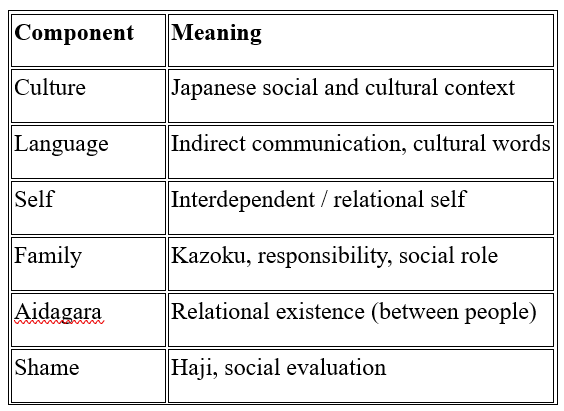
The Mud Lotus Model conceptualises trauma not only as a psychological injury, but as a disruption to identity, meaning, and relational existence, rather than solely as a psychological disorder. Rather than focusing only on symptom reduction or post-traumatic growth, the model proposes that recovery involves meaning integration, identity maintenance, and relational safety. Within this framework, suicide risk is understood not only as an individual psychological state, but as a relational and cultural phenomenon influenced by shame, social roles, family relationships, and loss of meaning. Therefore, risk and protection are located not only within the individual, but also within relational, cultural, and social contexts.
Table 5
Positioning the Mud Lotus Model Within Trauma Theory
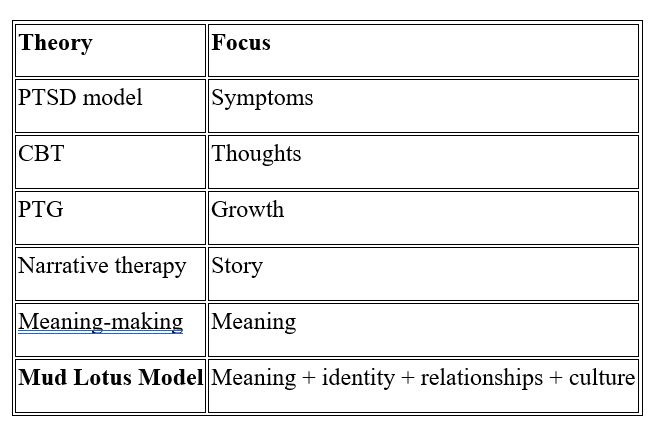
The Mud Lotus Model does not replace existing trauma models but extends them by incorporating cultural, relational, and meaning-based perspectives, particularly for clients from relational cultures such as Japan.
Implications for ACC Sensitive Claims and Counselling Practice
Culturally informed risk assessment with Japanese clients should include:
Table 6
Standard Risk Assessment and Culturally Informed Risk Assessment
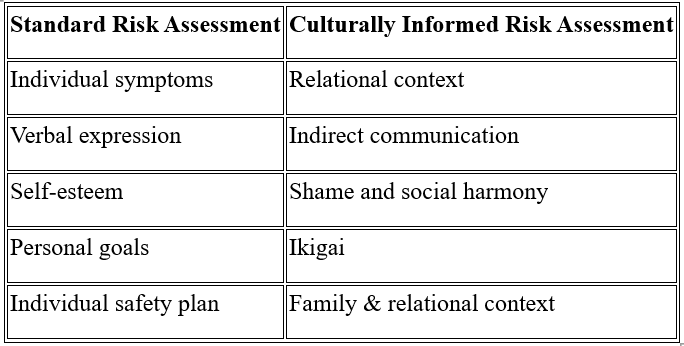
Language and cultural understanding are not simply preferences; they are clinically relevant factors in trauma counselling and risk assessment.
Table 7
Japanese Relational Risk Model
When working with clients from different cultural backgrounds, cultural humility is an important concept in counselling practice. Cultural humility involves an openness to understanding the client’s cultural perspective, recognising power differences between practitioner and client, and maintaining a respectful and reflective approach to cultural differences (Hook et al., 2013). In the context of working with Japanese clients, cultural humility includes understanding indirect communication, relational identity, and the cultural meanings of shame, family responsibility, and ikigai.
In the New Zealand context, the concept of cultural safety is also highly relevant. Cultural safety focuses on the client’s experience of care and whether the client feels respected, understood, and safe within the therapeutic relationship (Ramsden, 2002). Cultural safety is not only about cultural knowledge, but about power, respect, and the client’s ability to engage in services without feeling misunderstood or culturally unsafe. For Japanese clients, being able to communicate in their native language and work with a therapist who understands cultural concepts such as haji, kazoku, and indirect communication may be an important component of cultural safety in trauma counselling and sensitive claim work.
Contribution of the Mud Lotus Model
This paper makes three key contributions. First, it introduces the concept of relational risk, suggesting that suicide risk in some cultural contexts may exist not only at the individual level but also within relational and family systems.
Second, it integrates cultural concepts such as haji, aidagara, kazoku, and ikigai into a trauma and risk assessment framework. Third, it proposes the Mud Lotus Model as a cultural–relational meaning-making framework that can be applied in trauma counselling and ACC sensitive claim settings when working with Japanese clients.
The Mud Lotus Model contributes to trauma theory by introducing the concept of relational risk and proposing that trauma recovery involves meaning integration, identity maintenance, and relational safety within cultural contexts.
Limitations
This paper is a theoretical and practice-based paper drawing on cultural literature, clinical experience, and interdisciplinary theory rather than empirical data. Therefore, the Mud Lotus Model should be understood as a conceptual framework that requires further empirical research. Future research could examine culturally informed risk assessment, relational protective factors, and the role of language and indirect communication in trauma counselling with Japanese clients.
Conclusion
Understanding trauma and suicide risk among Japanese clients requires a cultural–relational perspective that includes language, shame, family relationships, and life meaning. The Mud Lotus Model provides a framework for understanding how culture, language, relational identity, and ikigai interact to influence both risk and protection. This model may be useful for counsellors, psychologists, and ACC providers working with Japanese clients in trauma and sensitive claim settings.
Future research could examine relational risk assessment, culturally informed safety planning, and the role of language and indirect communication in trauma counselling with Japanese clients. Empirical research may explore how relational protective factors such as family connection, social role, and ikigai influence suicide risk and recovery among Japanese clients in cross-cultural settings.
References
Bourdieu, P. (1986). The forms of capital. In J. G. Richardson (Ed.), Handbook of theory and research for the sociology of education (pp. 241–258). Greenwood.
Cooley, C. H. (1902). Human nature and the social order. Charles Scribner’s Sons.
Côté, J. E., & Levine, C. (2002). Identity formation, agency, and culture. Lawrence Erlbaum Associates.
Crenshaw, K. (1989). Demarginalizing the intersection of race and sex. University of Chicago Legal Forum, 1989(1), 139–167.
Farese, G. M. (2016). The cultural semantics of the Japanese emotion terms haji and hazukashii. New Voices in Japanese Studies, 8, 32–54.
Hall, E. T. (1976). Beyond culture. Anchor Press.
Hook, J. N., Davis, D. E., Owen, J., Worthington, E. L., & Utsey, S. O. (2013). Cultural humility: Measuring openness to culturally diverse clients. Journal of Counseling Psychology, 60(3), 353–366.
Kihara, A. (2026). Relational Risk Assessment: A Cultural–Relational Framework for Trauma and Risk Assessment with Japanese Clients. Hana Counselling. (Preprint)
Lebra, T. S. (1983). Shame and guilt: A psychocultural view of the Japanese self. Ethos, 11(3), 192–209.
Markus, H. R., & Kitayama, S. (1991). Culture and the self: Implications for cognition, emotion, and motivation. Psychological Review, 98(2), 224–253. https://doi.org/10.1037/0033-295X.98.2.224
McAdams, D. P. (2001). The psychology of life stories. Review of General Psychology, 5(2), 100–122. https://doi.org/10.1037/1089-2680.5.2.100
Ohnuki-Tierney, E. (1984). Illness and culture in contemporary Japan: An anthropological view. Cambridge University Press.
Ozawa-de Silva, C. (2008). Too lonely to die alone: Internet suicide pacts and existential suffering in Japan. Culture, Medicine and Psychiatry, 32, 516–551. doi: 10.1007/s11013-008-9108-0.
Park, C. L. (2010). Making sense of the meaning literature: An integrative review of meaning making and its effects on adjustment to stressful life events. Psychological Bulletin, 136(2), 257–301. https://doi.org/10.1037/a0018301
Ramsden, I. (2002). Cultural safety and nursing education in Aotearoa and Te Waipounamu (Doctoral thesis, Victoria University of Wellington, New Zealand).
Sone, T., Nakaya, N., Ohmori, K., Shimazu, T., Higashiguchi, M., Kakizaki, M., Kuriyama, S., & Tsuji, I. (2008). Sense of life worth living (ikigai) and mortality in Japan: Ohsaki Study. Psychosomatic Medicine, 70(6), 709–715.
Stanford University School of Medicine. (n.d.). Culturally appropriate care for Japanese patients.
Tseris, E. (2013). Trauma theory without feminism? Evaluating contemporary understandings of traumatic stress. Affilia, 28(2), 153–164. https://doi.org/10.1177/0886109913485707
Watsuji, T. (1996). Watsuji Tetsurō’s Rinrigaku: Ethics in Japan. State University of New York Press.
Yamamoto, N., & Wallhagen, M. I. (1997). The continuation of family caregiving in Japan. Journal of Health and Social Behavior, 38(2), 164–176.
Author Note
Ai Kihara is a counsellor and trauma-informed practitioner working with Japanese clients in New Zealand, particularly in the area of trauma and sensitive claims. Her work focuses on cultural safety, relational approaches to trauma, and meaning-making after trauma. The Mud Lotus Model was developed through clinical practice, cross-cultural work, and interdisciplinary study in sociology, psychology, and trauma theory.
