Integrating EMDR and the Japanese Zen concept

A Neurobiological and Contemplative Approach at Hana Counselling
At Hana Counselling, we integrate EMDR (Eye Movement Desensitization and Reprocessing) with Zen-informed mindfulness practices to support individuals recovering from trauma, including complex and relational trauma.
This integration is not spiritual bypassing, nor is it philosophical idealism.
It is a clinically grounded, neuroscience-informed approach that recognizes the deep interconnection between brain, body, and awareness.
1. What EMDR Does from a Neurobiological Perspective
Traumatic experiences are often stored in the brain as unintegrated memory networks, involving:
The amygdala (fear and threat response)
The hippocampus (time and context)
The prefrontal cortex (regulation, meaning-making, self-reflection)
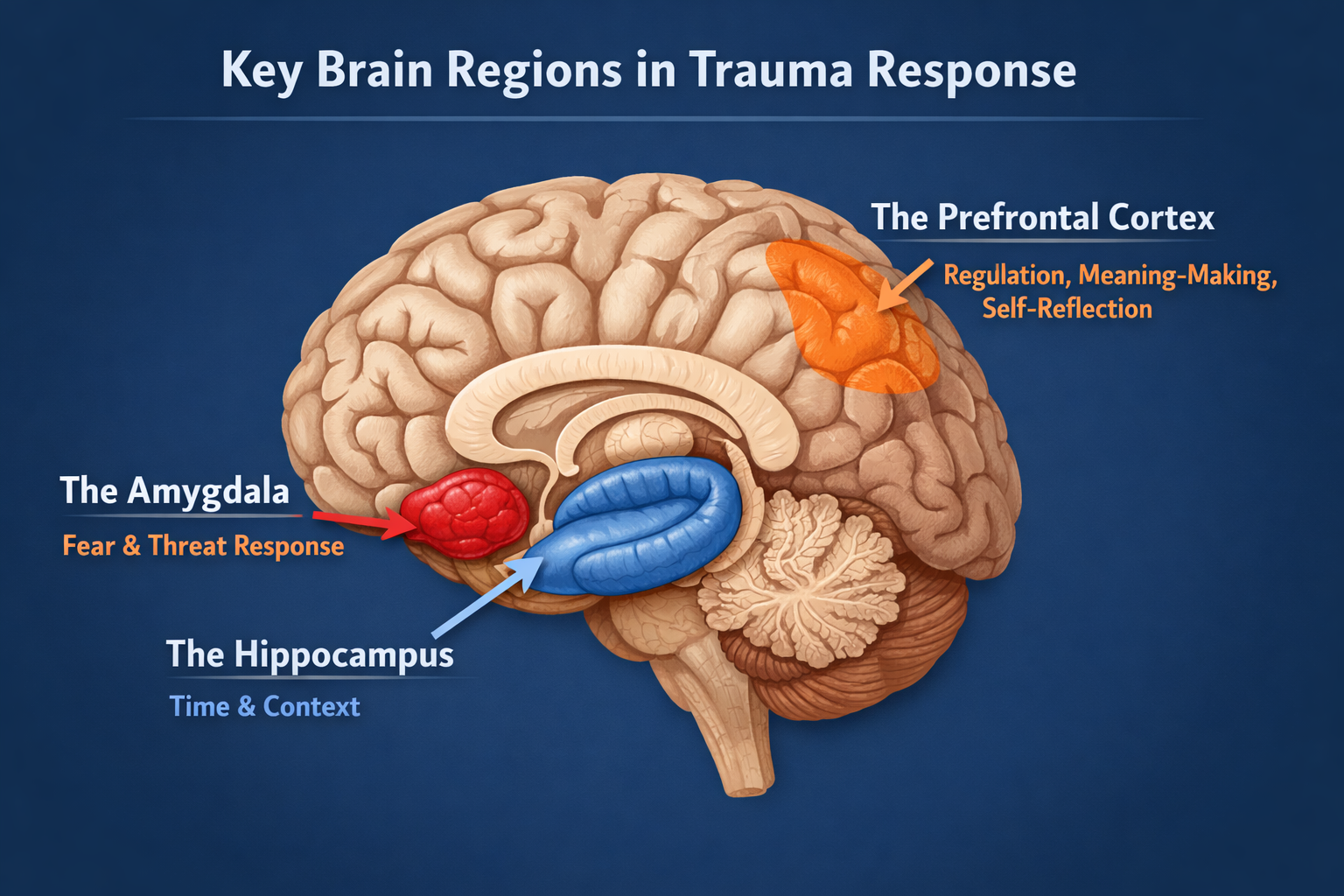
When trauma remains unprocessed, the nervous system reacts as if the event is still happening in the present.
EMDR uses bilateral stimulation (eye movements, tapping, or auditory cues) to facilitate adaptive information processing. Research shows that EMDR can:
Reduce limbic system overactivation
Restore temporal context (“this is in the past”)
Strengthen prefrontal regulation
Integrate traumatic memory into a coherent narrative
EMDR does not erase memory.
It allows the brain to process trauma safely and efficiently.

2. The Role of Zen and Mindfulness
Zen practice emphasizes:
Awareness of the present moment
Non-judgmental observation
The ability to notice thoughts and emotions without becoming them
From a neuroscience perspective, mindfulness practices are associated with:
Increased activity in the prefrontal cortex
Reduced amygdala reactivity
Improved autonomic nervous system regulation
Greater emotional resilience
Zen is not about suppressing emotion.
It cultivates the capacity to remain present without being overwhelmed.
3. Why EMDR and Zen Are Integrated
EMDR and Zen operate on different but complementary levels:
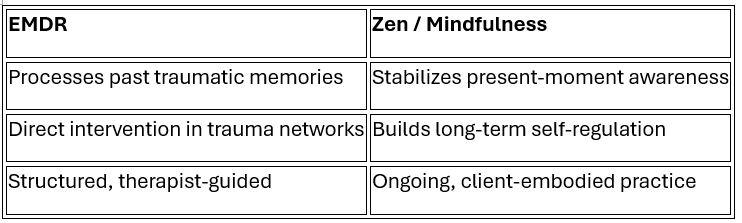
When combined:
EMDR addresses deep, stored trauma
Zen provides a stable nervous system foundation that supports integration and prevents retraumatization
This integration allows healing to extend beyond the therapy room and into daily life.
4. Clinical Relevance for DV and Complex Trauma
Individuals exposed to domestic violence or prolonged coercive control often experience:
Chronic hypervigilance
Autonomic nervous system dysregulation
Emotional reactivity that precedes conscious thought
Difficulty sensing safety, even when safe
EMDR helps resolve trauma at the memory level.
Zen-informed practices support ongoing nervous system stabilization and self-observation.
Together, they facilitate a transition from:
“I can calm down only in therapy”
to
“I can remain grounded in my own life.”
5. Where Zen and Neuroscience Converge
Key Zen concepts align closely with neurobiological findings:
Impermanence: emotions and thoughts are transient
→ neural states are not fixed identitiesNon-identification (non-self): feelings are not the self
→ development of metacognitionMindful awareness (right attention): returning to the present
→ restoration of top-down neural regulation
What Zen has articulated for centuries, neuroscience now describes as
integration between emotional and regulatory brain systems.
6. Our Clinical Values at Hana Counselling
At Hana Counselling, we do not:
Ask clients to endure distress through meditation
Encourage forgiveness or reconciliation as a therapeutic goal
Use mindfulness to bypass trauma or minimize harm
Safety, agency, and boundaries are foundational.
Healing is understood as
reclaiming ownership of one’s nervous system and inner experience.
Conclusion
The integration of EMDR and Zen offers a pathway to:
Process the past
Stabilize the present
Restore choice and agency for the future
Hana Counselling remains committed to trauma-informed, neuroscience-based, and ethically grounded care that honors the complexity of human experience.
References
Shapiro, F. (2018). Eye Movement Desensitization and Reprocessing (EMDR) Therapy.
Siegel, D. J. (2012). The Developing Mind.
van der Kolk, B. (2014). The Body Keeps the Score.
Davidson, R. J., & Lutz, A. (2008). Buddha’s Brain.
Kabat-Zinn, J. (1994). Wherever You Go, There You Are.