
Why DV Perpetrators Are Often Perceived as “Trustworthy”- A Neuropsychological and Social Perspective

One of the most damaging aspects of domestic violence is that perpetrators are frequently perceived by others as reasonable, credible, and trustworthy. This is not accidental.
1. Selective Self-Regulation and Social Performance
Many DV perpetrators demonstrate intact or highly developed self-control in public and professional settings.
Neuropsychologically, this reflects selective regulation rather than an absence of control:
Emotional dysregulation is expressed in private, intimate relationships
In public, prefrontal control is activated to maintain a socially acceptable persona
This allows perpetrators to:
Appear calm, articulate, and rational
Present coherent narratives in legal or professional contexts
Contrast themselves with victims who may appear emotionally dysregulated due to trauma
Importantly, this is not a lack of control, but context-dependent control.
2. Trauma-Based Inversion: “I Am the Victim”
Some perpetrators exhibit chronic amygdala hyperactivation, leading to distorted threat perception. As a result:
Neutral boundaries feel like attacks
Accountability feels threatening or humiliating
Defensive aggression is cognitively reframed as self-protection
This produces the commonly observed phenomenon in DV cases:
The perpetrator sincerely experiences themselves as the victim.
This does not absolve responsibility; it explains why their narrative can appear internally consistent and emotionally convincing.
3. Narrative Control and Cognitive Dominance
DV perpetrators often engage in narrative management:
Preemptively framing the victim as unstable or manipulative
Positioning themselves as calm, concerned, and cooperative
Using professional or legal language strategically
From a cognitive standpoint, this reflects dominance in meaning-making, not truthfulness. Victims’ trauma responses (fragmented memory, emotional reactivity) can be misread as unreliability.
4. Social Biases That Protect Perpetrators
Perpetrators benefit from systemic and cognitive biases, including:
Calm = credible
Emotional = irrational
Gendered expectations around anger and authority
Institutional discomfort with complexity and ambiguity
These biases, combined with deliberate self-presentation, reinforce perceived trustworthiness.
5. Trustworthiness as a Tool of Coercive Control
Social trust is not incidental—it is instrumental. By being perceived as trustworthy, perpetrators:
Isolate victims
Undermine disclosures
Maintain power across legal, medical, and social systems
Perceived credibility becomes an extension of coercive control.
6. How to Recognize If Your Partner Is Abusing You
Understanding why DV perpetrators appear credible is essential. Without this lens, victims may be blamed or dismissed. Here’s how abuse can be identified, even when the perpetrator seems trustworthy.
Emotional and Psychological Abuse
Emotional abuse often includes patterns that:
Undermine confidence and self-worth
Make you doubt your perceptions or memories
Create fear, anxiety, or hypervigilance
Isolate you from friends, family, or support

Gaslighting is a particularly insidious form of emotional abuse.
Gaslighting: Behaviors to Watch
Gaslighting manipulates your perception of reality. Examples include:
Denying or minimizing abusive actions: “I never did that,” or “You’re overreacting.”
Blaming you for their behavior: “This wouldn’t have happened if you hadn’t done X.”
Distorting facts or events: “You imagined that,” or “That never happened.”
Shifting responsibility: “I’m the victim here, not you.”
Using insecurities against you: “You’re too sensitive.”
Manipulating perception of others: “Nobody will believe you.”
Repeating false narratives to control the story, including in legal or professional settings.
Other Signs of Partner Abuse
Control over time, finances, or activities
Excessive jealousy or accusations of infidelity
Threats, intimidation, or humiliation
Physical aggression or coercion
Isolation from support networks
Constant monitoring or surveillance
Manipulating others to doubt your experiences
Steps to Protect Yourself
Trust your instincts: Your feelings of unease are valid.
Document incidents: Keep factual records of words, actions, dates.
Seek professional support: Counsellors, therapists, or domestic violence services.
Build a safety plan: Trusted people, safe places, emergency contacts.
Know your rights: Legal protections exist for survivors of abuse.
Abuse is never the victim’s fault. Recognizing the signs is the first step toward regaining safety, autonomy, and peace of mind.
7. Clinical Integration: EMDR × Zen
Understanding a perpetrator’s perceived credibility also informs trauma recovery. EMDR addresses the survivor’s trauma-based dysregulation, and Zen-informed mindfulness rebuilds self-observation and nervous system coherence. Healing is not only personal—it restores the capacity to trust your own reality.
8. What Happens in the Brain of DV Perpetrators and Survivors
Neuroscience helps explain the behaviors and experiences in abusive relationships. Understanding these mechanisms clarifies why perpetrators can seem credible and why victims’ responses are often misread.
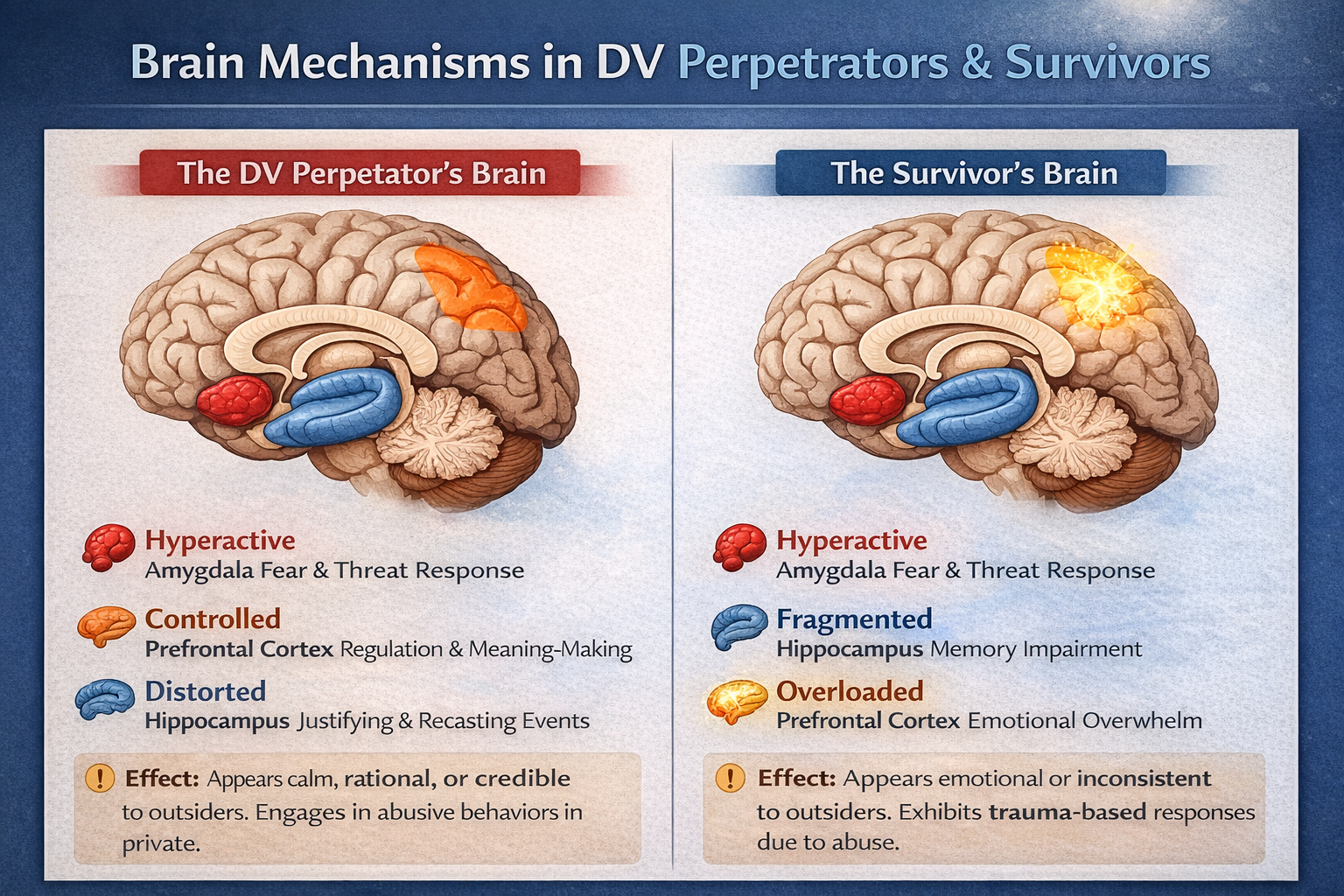
A. The DV Perpetrator’s Brain
Amygdala – Fear and Threat Response
Overactive or hypervigilant in perceived threats.
Even minor boundary-setting may trigger defensive aggression.
Prefrontal Cortex – Regulation and Meaning-Making
Can remain highly active in public or professional settings.
Allows the perpetrator to control emotions, appear calm, and craft believable narratives, even while being abusive in private.
Hippocampus – Contextual Memory
Can distort memories selectively to justify their actions or recast themselves as the victim.
Effect: This combination explains why perpetrators can present themselves as rational, calm, and trustworthy to outsiders, while simultaneously engaging in coercive or abusive behaviors in private.
B. The Survivor’s Brain
Amygdala – Hyperactivation
Heightened fear and threat response, especially after repeated abuse.
Triggers anxiety, startle responses, and hypervigilance.
Hippocampus – Contextual Fragmentation
Stress and trauma can fragment memory.
Victims may struggle to recall events linearly, which can make them appear inconsistent in legal or social settings.
Prefrontal Cortex – Regulation Overload
Constantly working to control emotions under threat.
Cognitive resources are diverted to safety and coping, which can reduce clarity in storytelling or assertiveness.
Effect: These neural patterns can make survivors appear “emotional” or “unstable” to others, which perpetrators may exploit in courts, workplaces, or social situations.
C. Why This Matters
Understanding these brain mechanisms helps:
Explain why perpetrators appear trustworthy while victims’ credibility is questioned
Highlight that survivors’ responses are neurobiologically normal reactions to trauma
Support trauma-informed practices like EMDR and mindfulness, which aim to retrain the nervous system and restore confidence in reality perception

Empowerment and Healing: Hana Counselling Perspective
"Even after trauma, your life has meaning, and your path forward is yours to reclaim. At Hana Counselling, we guide survivors to reconnect with their ikigai—the deep sense of purpose that gives life vitality. Through Zen mindfulness, you can observe thoughts and emotions without being overwhelmed, cultivating clarity and presence. Self-compassion reminds you that your reactions are natural responses to trauma, not signs of weakness. Drawing on Naikan reflection, you can acknowledge what others have contributed to your life while recognizing your own resilience and strengths. Morita Therapy teaches acceptance of feelings without overidentifying with them, and taking purposeful action despite discomfort. Together, these approaches restore agency, calm the nervous system, and empower survivors to live with clarity, dignity, and hope."- Ai Kihara (Director at Hana counselling)
References
Bancroft, L. (2002). The Batterer as Parent
Stark, E. (2007). Coercive Control
Herman, J. L. (1992). Trauma and Recovery
Siegel, D. J. (2012). The Developing Mind
van der Kolk, B. (2014). The Body Keeps the Score
