Mud Lotus Movement and Wellbeing Programme
Developed by Ai Kihara (Trauma specialist/Researcher)
Founder of HANA and Creator of the Mud Lotus Movement and Wellbeing Model
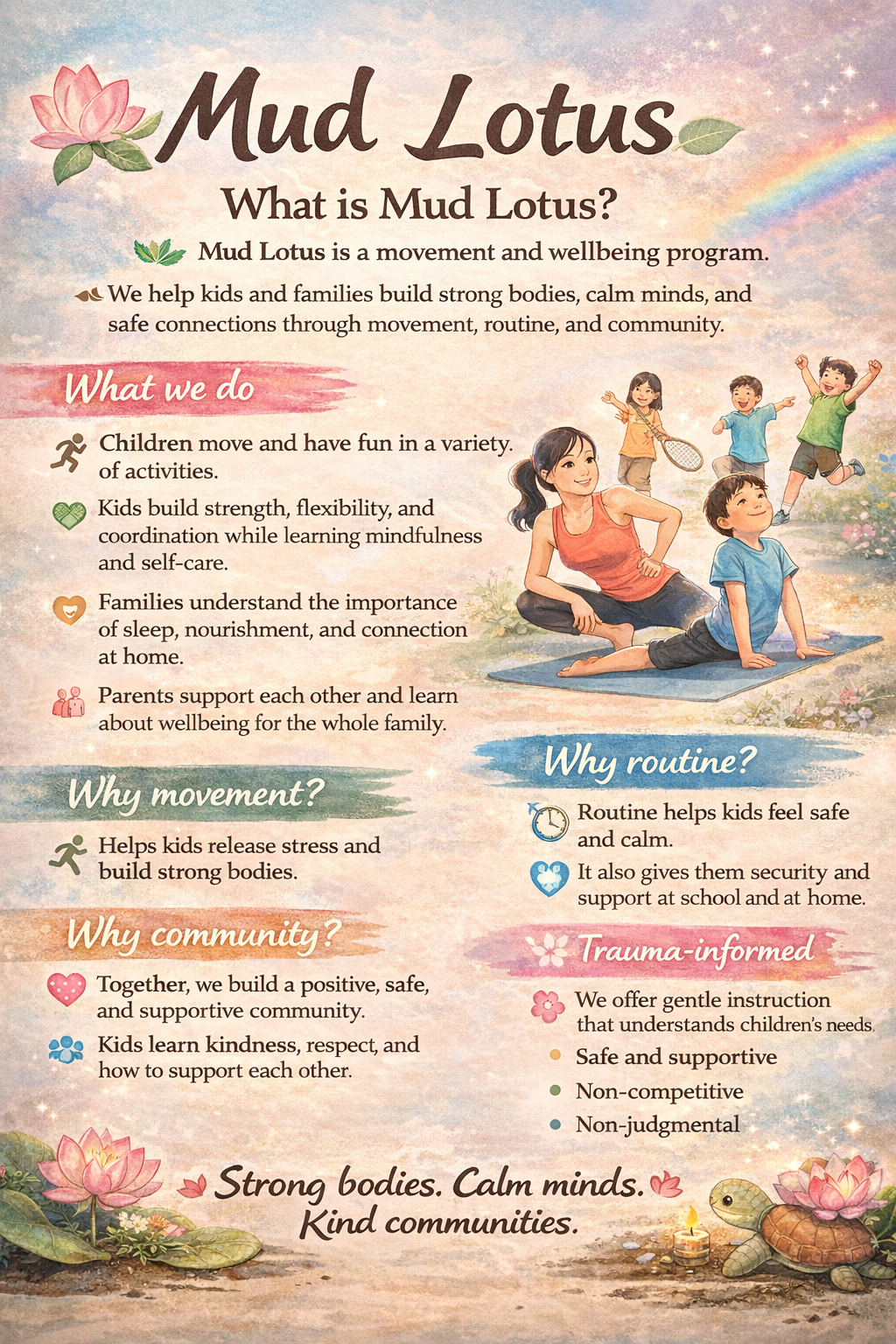
The Mud Lotus Movement and Wellbeing Programme is a creative movement and wellbeing programme designed for tamariki and rangatahi aged 5–18 years.
Our programme supports children and young people to build confidence, emotional awareness, physical wellbeing, and positive social connections through movement-based experiences.
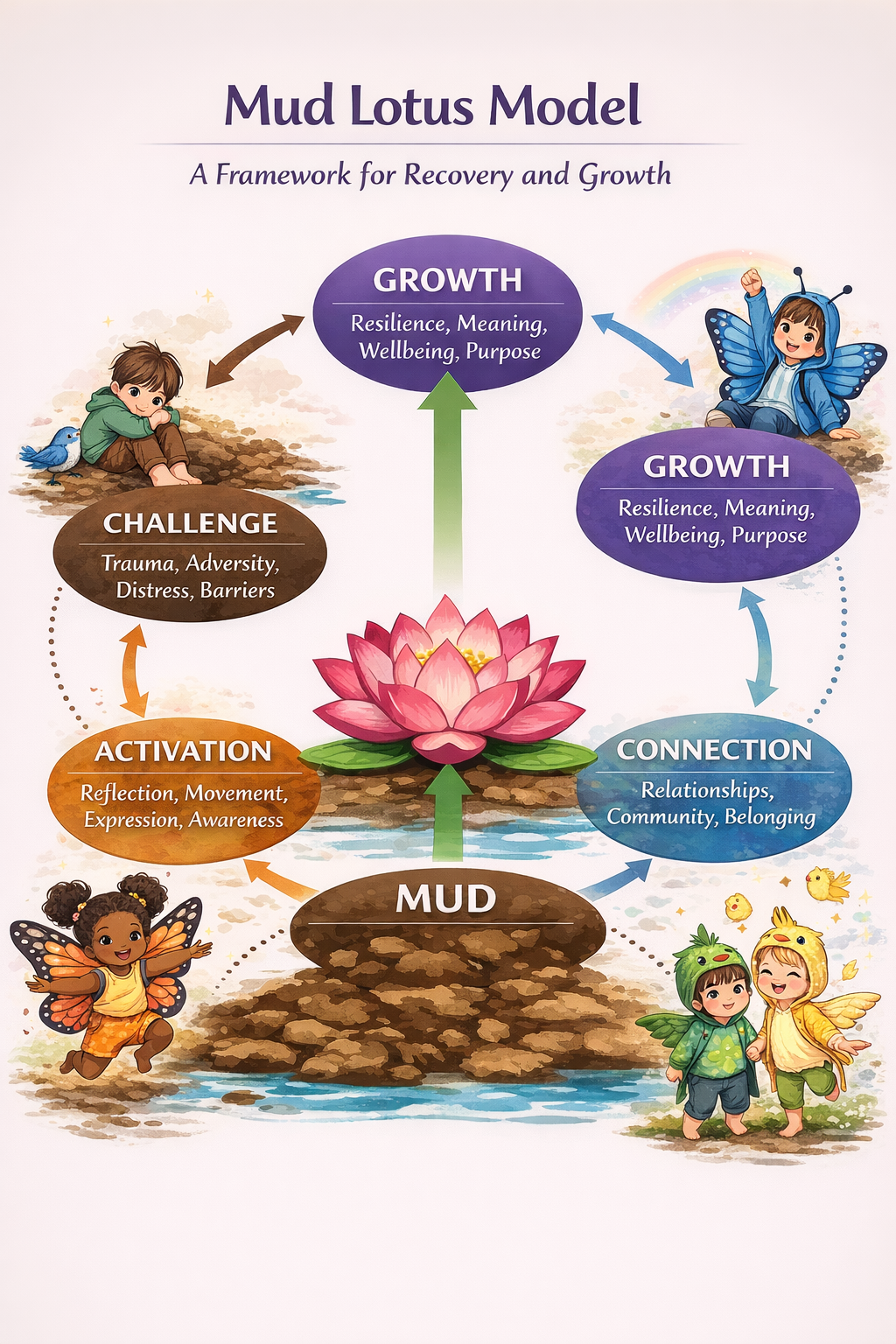
Inspired by the lotus flower, which grows through the mud before it blooms, Mud Lotus teaches that growth, resilience, and confidence can develop through challenge, support, and connection.
What Happens in the Programme?
Participants engage in:
Creative movement and dance
Fun physical activities
Age-appropriate non-contact self-defence
Emotional awareness activities
Body awareness and mindfulness
Confidence-building exercises
Community connection and teamwork
Reflection and personal growth activities
The programme combines movement, wellbeing education, and social connection in a safe and inclusive environment.
Why Community Programmes Matter for Children and Young People
An evidence-informed community wellbeing programme
More Than an Activity. More Than Therapy.
At Mud Lotus, we believe that children grow not only through individual learning, but also through meaningful connection with others. Research from community psychology, sociology, and public health shows that wellbeing is strongly influenced by relationships, belonging, participation, and connection to community (Durie, 1998; Hodgetts et al., 2017).
While individual therapy can be valuable, children and young people also benefit from opportunities to learn, play, move, and grow alongside others.
Community programmes help children develop:
A sense of belonging
Positive friendships
Confidence and resilience
Empathy and social skills
Leadership and contribution
Healthy connections with trusted adults
These experiences are important protective factors that support lifelong wellbeing (Felitti et al., 1998; Hodgetts et al., 2022).
Why Not Just Individual Therapy?
Individual therapy focuses on helping a child understand and work through personal challenges. Community programmes offer something different.
Children learn:
I am not alone.
Other children experience challenges too.
I can support others.
I belong here.
I have strengths to share.
These lessons are often learned through participation, movement, cooperation, and shared experiences rather than conversation alone. Research suggests that social connection and community participation play a significant role in mental health, resilience, and recovery (Hodgetts et al., 2017; Paul & Ratana, 2022).
The Importance of Belonging
Children thrive when they feel connected to others. Community psychology recognises that belonging and supportive relationships are essential for healthy development and wellbeing (Hodgetts et al., 2022).
When children experience belonging, they are more likely to:
Participate confidently
Develop positive friendships
Build emotional security
Ask for help when needed
Support others
Feel valued and accepted
A strong sense of belonging can help protect children against the negative effects of stress, adversity, and social isolation (Felitti et al., 1998).
The Mud Lotus Perspective
The Mud Lotus Movement and Wellbeing Model was created by Ai Kihara, Director of HANA. The model integrates trauma-informed practice, movement-based wellbeing, emotional learning, and community connection. At Mud Lotus, we understand that challenges are part of life. However, children do not grow through challenge alone. Growth happens when challenge is met with movement, support, connection, and opportunity.
This is represented through the Mud Lotus pathway:
Mud → Move → Connect → Grow
Trauma and adversity can often create isolation. Movement helps children reconnect with their bodies. Connection helps children reconnect with others. Community helps children discover that they belong and that they are part of something larger than themselves. This approach aligns with community psychology principles and Māori models of wellbeing that recognise the importance of relationships, participation, belonging, and collective wellbeing (Durie, 1998).
What Makes Mud Lotus Different?
Mud Lotus is not simply a dance class, self-defence class, or wellbeing activity.
It is a community-based wellbeing programme that combines:
Creative Movement
Emotional Learning
Self-Defence and Personal Safety
Healthy Habits
Community Connection
Confidence Building
Through shared experiences, children learn that wellbeing is not something we build alone. It grows through movement, relationships, contribution, and connection.
Our Goal
Our goal is not simply to help children perform better.
Our goal is to help them develop:
Confidence
Belonging
Resilience
Emotional Awareness
Connection
Wellbeing
Because every child deserves opportunities not only to grow individually, but also to grow together.
References
Durie, M. (1998). Whaiora: Māori health development (2nd ed.). Oxford University Press.
Felitti, V. J., Anda, R. F., Nordenberg, D., Williamson, D. F., Spitz, A. M., Edwards, V., Koss, M. P., & Marks, J. S. (1998). Relationship of childhood abuse and household dysfunction to many of the leading causes of death in adults: The adverse childhood experiences (ACE) study. American Journal of Preventive Medicine, 14(4), 245–258. https://doi.org/10.1016/S0749-3797(98)00017-8
Hodgetts, D., Stolte, O., & Rua, M. (2017). Psychological practice, social determinants of health, and the promotion of human flourishing. In I. M. Evans, J. Rucklidge, & M. O'Driscoll (Eds.), Professional practice of psychology in Aotearoa New Zealand (pp. 31–49). New Zealand Psychological Society.
Hodgetts, D., Rua, M., Groot, S., Hopner, V., Drew, N., King, P., & Blake, D. (2022). Relational ethics meets principled practice in community research engagements to understand and address homelessness. Journal of Community Psychology, 50(4), 1980–1992. https://doi.org/10.1002/jcop.22586
Paul, J., & Ratana, M. (2022). Youth homelessness in Tāmaki Makaurau, Aotearoa New Zealand: A scoping report prepared for Manaaki Rangatahi ki Tāmaki Makaurau Youth Homelessness Collective. Ngā Wai a Te Tūī Māori and Indigenous Research Centre. van der Kolk, B. A. (1994). The body keeps the score: Memory and the evolving psychobiology of posttraumatic stress. Harvard Review of Psychiatry, 1(5), 253–265.
-
Many young people experience barriers to participation in sport and recreation.
Some may struggle with:
Anxiety
Low confidence
Social difficulties
Feeling uncomfortable in traditional sporting environments
Mud Lotus uses movement as a pathway to wellbeing, helping participants develop:
Identity
Sense of self
Confidence
Emotional awareness
Body awareness
Social connection
Sense of belonging
Gain positive connection between body and mind
-
Families play an important role in supporting children and young people.
We encourage caregivers to support participants by:
Encouraging movement and play
Listening and showing curiosity
Celebrating strengths and effort
Supporting healthy routines
Helping children stay connected to supportive people
-
Participants may experience:
Increased confidence
Greater emotional awareness
Improved body awareness
Stronger social connections
Increased participation in physical activity
Greater sense of belonging and wellbeing
-
All facilitators are experienced, caring, and supportive professionals committed to creating a safe and inclusive environment for every participant.
The programme is overseen by Ai Kihara, Director of Hana Counselling, who specialises in mental health, trauma recovery, and child and adolescent wellbeing.
Ai is also the creator of the Mud Lotus Movement and Wellbeing Model, a trauma-informed framework developed through her work in counselling, community wellbeing, youth development, and movement-based practice.
Inspired by the lotus flower that grows through the mud before it blooms, the Mud Lotus Model teaches that confidence, resilience, wellbeing, and connection can emerge through challenge, support, movement, and community.
The programme follows the Mud Lotus pathway:
Mud → Move → Connect → Grow
Through creative movement, emotional learning, wellbeing education, and positive social connection, children and young people are supported to develop confidence, self-awareness, belonging, and resilience.
If you have any questions about the programme, please feel free to contact us. We are happy to discuss how we can support your child’s wellbeing and growth.
-
Mud → Move → Connect → Grow
Mud Lotus is built around a simple pathway:
Mud
Sometimes life feels hard, confusing, or overwhelming.Move
Movement helps us regulate emotions, build confidence, and reconnect with our bodies.Connect
We grow through supportive relationships and community.Grow
Confidence, resilience, and wellbeing emerge through experience and practice.This journey reminds young people that they are not defined by their struggles. Growth can happen even during difficult times.