The Lotus in the Mud- An Integrative Approach to Trauma Recovery, Healing, and Post-Traumatic Growth in the Zen Moment; A Hana Counselling Trauma Integration Model
Introduction
Trauma treatment often focuses primarily on reducing symptoms such as:
Flashbacks
Anxiety
Hyperarousal (hypervigilance)
Difficulties with emotional regulation
Addressing these symptoms is, of course, important.
However, recovery from trauma is not simply about eliminating distress.
As a trauma therapist and trauma researcher, I often reflect on the nature of recovery. In my experience, trauma recovery involves more than treating PTSD symptoms. Two elements are particularly important:
finding meaning in past trauma
experiencing healing in relation to that trauma
Even when PTSD symptoms no longer appear after a trigger, some clients still struggle with unresolved emotions.
Some say:
“I was hurt. My life was destroyed. I cannot forgive the person who harmed me.”
Others are left with regret or self-blame:
“Why did that happen to me? Maybe I was foolish to end up traumatized.”
In many cases, these lingering struggles arise because the trauma experience has not yet been given meaning, and emotional healing has not fully occurred.
Furthermore, many trauma survivors are not simply resting and attending therapy. They are living full lives—working, studying, raising children, or caring for aging parents.
For this reason, I believe that trauma recovery must also involve developing the capacity to live without breaking, even in the storms of life.
Through both clinical experience and personal reflection, I have come to understand trauma recovery through a metaphor often found in Zen philosophy:
“The lotus flower blooms only in the mud.”
Pain, confusion, injustice, and loss do not simply disappear with time.
People often say, “Time heals everything.”
In reality, time alone does not heal trauma.
Recovery emerges when people develop the strength to remain standing—even in the midst of life's storms.
In this paper, I introduce a trauma treatment model that integrates the following approaches:
Each of these approaches addresses a different layer of trauma integration. When combined, they may support not only recovery but also:
Why an Integrative Approach Is Necessary
Trauma affects multiple human systems simultaneously, including:
Neural memory networks
Emotional regulation
Cognitive meaning-making
Identity and life narrative
Bodily experience
It is difficult for any single psychotherapeutic approach to address all of these domains.
An integrative model allows recovery to occur across multiple levels:
brain, body, and meaning.
Layer 1: Processing Traumatic Memory
EMDR
EMDR (Eye Movement Desensitization and Reprocessing) is a psychotherapy designed to process traumatic memories that are stored in a dysfunctional form within the brain.
Traumatic memories are often retained in a “frozen” state. Even when the event is long past, these memories can continue to trigger:
intense emotional responses
physical reactions
EMDR helps process these memories and integrate them into the broader adaptive memory network of a person's life.
As a result:
emotional intensity decreases
cognitive flexibility increases
Layer 2: Acceptance of Emotion
Morita Therapy
Morita Therapy, developed in Japan, offers an important perspective for trauma recovery.
Its central principle is:
Rather than trying to eliminate emotions, we learn to accept them as they are.
Morita Therapy views emotions as natural phenomena rather than problems that must be eradicated.
People often struggle intensely to eliminate anxiety or suffering. However, that struggle itself can amplify distress.
By learning to live alongside emotional storms, individuals often develop deeper psychological stability.
Layer 3: Reconstruction of Meaning
Naikan Therapy
Naikan Therapy is a method of deep self-reflection that invites individuals to reconsider their relationships with others.
Traditionally, Naikan reflection centers on three questions:
What have I received from others?
What have I given back to others?
What troubles or difficulties have I caused others?
In my clinical practice, I sometimes adapt the third question slightly:
“What have I learned from this relationship?”
This shift redirects attention away from guilt and toward:
meaning-making
growth
Reconstructing trauma as a meaningful life experience can be an important step in recovery.
Layer 4: Stabilizing the Nervous System
Zen Mindfulness
Zen mindfulness cultivates the ability to observe internal experiences.
In practice, individuals learn to observe:
thoughts
emotions
bodily sensations
without becoming overwhelmed by them.
There is a saying in Zen:
“Do not try to stop the storm.
Be a quiet lake within the storm.”
This practice creates psychological space within the mind.
Layer 5: Releasing Trauma Through the Body
Dance/Movement Therapy
Trauma is stored not only in memory but also in the body.
Dance and Movement Therapy allows emotional expression through physical movement rather than words.
Through movement, individuals may experience:
nervous system release
emotional expression
restoration of bodily safety
This approach can be particularly helpful when trauma is difficult to verbalize.
Layer 6: Nonverbal Integration
Zen Art Therapy
Art therapy provides a pathway for nonverbal integration.
In Zen-inspired artistic practice, the emphasis is on:
simplicity
presence in the moment
a non-judgmental attitude
The value lies not in the aesthetic quality of the artwork, but in authentic expression.
Creative processes often access emotional layers that words cannot reach.
The Lotus Model of Trauma Recovery
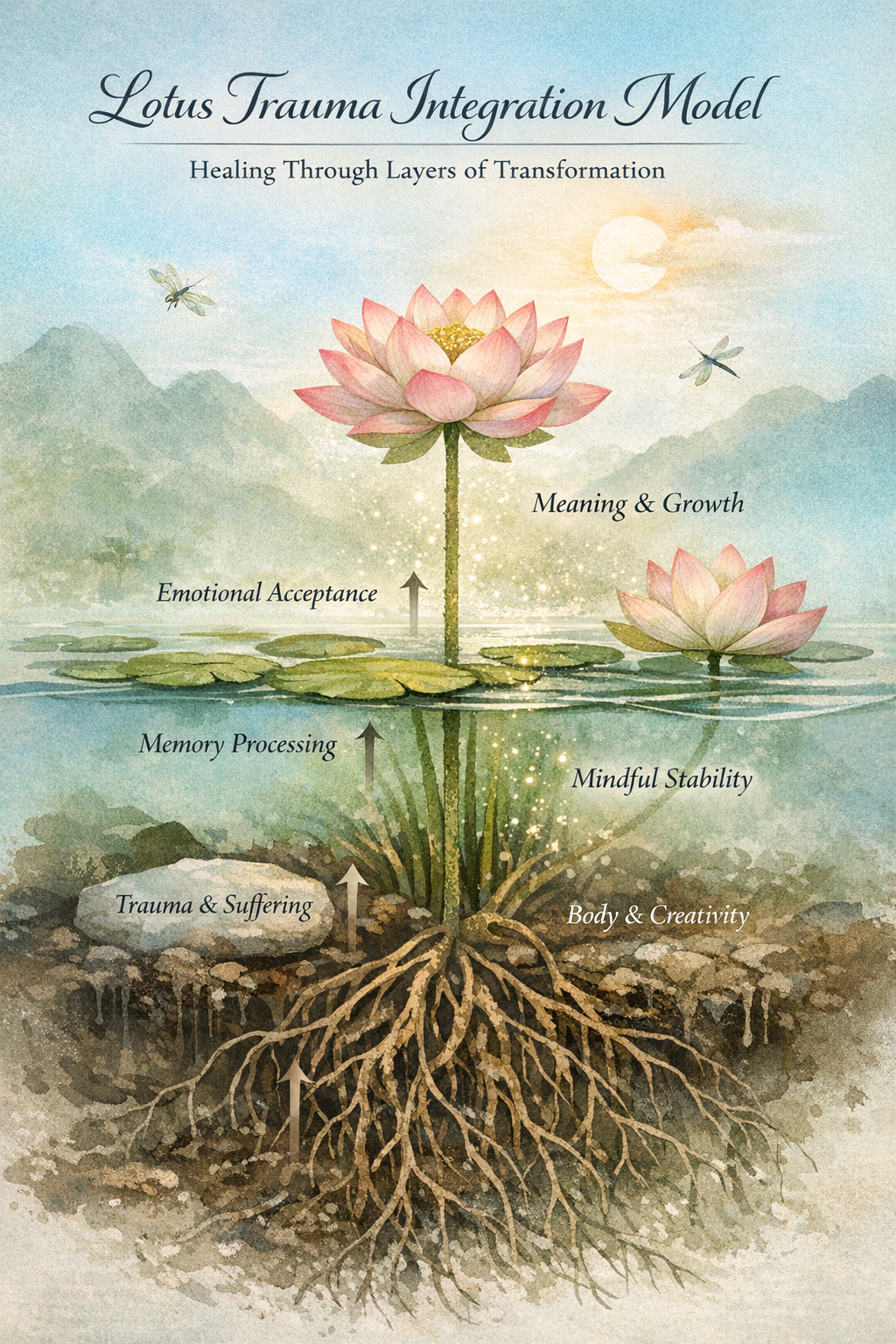
This is Ai Kihara’s original Model
When these approaches are integrated, trauma recovery can be understood through what I call the Lotus Model.
The lotus grows in mud and rises toward the surface of the water.
Each layer corresponds metaphorically to a part of this process:
Mud
→ Trauma and suffering
Roots
→ Acceptance of emotion (Morita Therapy)
Stem
→ Memory processing (EMDR)
Water surface
→ Mental stability (Zen mindfulness)
Flower
→ Reconstruction of meaning (Naikan reflection)
Petals
→ Integration through body and creativity (movement and art)
Trauma may never disappear completely.
Yet from within the mud, new growth can emerge.
Being in the mud can feel dark, cold, and suffocating. It may feel impossible to breathe or move.
But if we do not panic and continue searching, we may find tools—like goggles, an oxygen tank, or a helping hand from someone who notices we are drowning.
And if no one is there to offer that hand, our future self can become that hand.
Conclusion
Trauma recovery does not mean becoming invincible.
It means developing the strength to keep walking without breaking—even in the storms of life.
Strength is not the absence of suffering.
Strength is quiet resilience.
In Japanese, I believe this quality is captured by the word Kyoji (衿持)—a quiet dignity and inner pride.
Like the lotus flower:
graceful, resilient, and strong.
Copyright Notice
© 2026 Hana Counselling Limited.
The Mud Lotus Programme, including its curriculum, programme structure, educational materials, workbook, graphics, learning resources, presentation materials, and associated written content, is protected by New Zealand copyright law.
No part of this programme may be reproduced, adapted, distributed, or delivered without the prior written permission of Hana Counselling Limited.