
The Mud Lotus Trauma Integration Model:An Integrative Conceptual Framework Linking Trauma, Emotion, and Zen

Are We Really Suffering from Our Emotions?
Introduction
The Substance Abuse and Mental Health Services Administration (SAMHSA, 2014) defines trauma as an event, series of events, or set of circumstances that is experienced as physically or emotionally harmful or life-threatening and has lasting adverse effects on an individual's mental, physical, emotional, social, or spiritual well-being. Likewise, van der Kolk (2014) argues that trauma is not simply stored as a memory of past events; it is also held within the body.
In clinical practice, the effects of trauma appear in many different forms. Among the concerns I hear most frequently are:
"I can't control my emotions."
"My emotions completely overwhelm me."
"I don't even know what I'm feeling, but my body feels unbearable."
These experiences are remarkably common among people living with trauma.
However, this raises an important question.
Are we truly suffering from our emotions themselves?
Modern psychology and neuroscience suggest that the answer may be more complex than we often assume.
Emotion and Feeling Are Not the Same
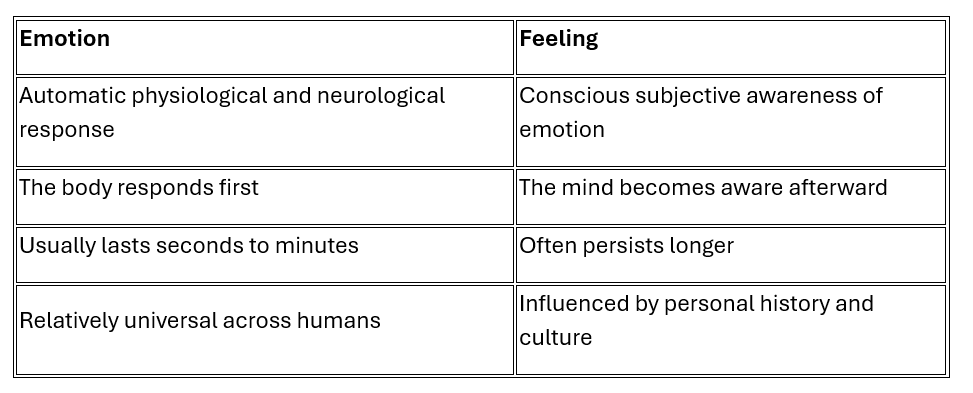
In everyday language, the words emotion and feeling are often used interchangeably. However, neuroscience distinguishes these as separate processes.
According to neuroscientist Antonio Damasio (1999), emotion refers to automatic physiological and neurological responses that occur within the body, whereas feeling refers to the conscious subjective experience that arises when the brain becomes aware of those bodily changes.
In other words, the body reacts first.
Only afterward do we consciously experience those bodily reactions as feelings such as fear, anxiety, sadness, or relief.
Subsequently, the mind begins to interpret and assign meaning to those experiences.
This distinction suggests that what we commonly call "emotion" is not a single psychological event but rather a sequence of interconnected processes.
Emotion and Feeling
Why Do People Experience the Same Event Differently?
Imagine attending a job interview.
Almost everyone experiences some degree of physiological arousal before entering the interview room. The heart beats faster, breathing changes, and muscles become slightly tense. These automatic bodily responses are normal.
What differs is the interpretation that follows.
One person may think,
"I'm probably going to fail."
Another person may think,
"The interviewer looks busy. They must have had a long day."
Although the external situation is identical, the internal experience becomes completely different.
Cognitive Behavioural Therapy (CBT) explains this difference through the concept of interpretation (Beck, 2020).
The Cognitive Behavioural Perspective
How does CBT explain this process?
Aaron Beck proposed that it is not events themselves that determine emotional and behavioural responses, but rather the way those events are interpreted (Beck, 2020).
Many people naturally assume that situations directly produce emotions.
CBT offers a different perspective.
It proposes that the meaning we assign to an event largely determines our emotional experience and subsequent behaviour.
This process can be described as follows:
Stimulus
↓
Interpretation
↓
Emotional Experience
↓
Behaviour
Importantly, interpretations do not arise in isolation.
They are shaped by an individual's life experiences, cultural background, family rules, and previous learning.
Interestingly, people often respond not only to the present event itself, but also to memories and beliefs from the past that are unconsciously activated by the current situation.
Within CBT, these deeper assumptions are referred to as core beliefs (Beck, 2020).
Core beliefs are fundamental assumptions about oneself, other people, and the world.
Over time, these core beliefs combine to form a person's broader belief system—the psychological lens through which reality is interpreted.
How Belief Systems Shape Emotional Experience: A Clinical Illustration
CBT proposes that interpretations are influenced by an individual's underlying belief system. These beliefs are not formed overnight; rather, they develop through repeated life experiences, relationships, culture, and family environments.
To illustrate this process, consider the following hypothetical example.
Person A
Person A experienced childhood abuse and continued to encounter repeated interpersonal conflicts throughout adulthood. These relationship difficulties eventually led to financial problems and increasing social isolation.
Over time, Person A may develop core beliefs such as:
Beliefs about the self
"I am an unfortunate person."
Beliefs about others
"People will eventually hurt me."
Beliefs about the world
"The world is dangerous."
Person B
By contrast, Person B grew up in a supportive family environment, developed healthy friendships, and generally experienced positive interpersonal relationships.
As a result, Person B may develop different core beliefs:
Beliefs about the self
"I am a capable and worthwhile person."
Beliefs about others
"People are generally supportive."
Beliefs about the world
"The world is fundamentally safe."
Although both individuals encounter exactly the same external event, their internal experiences are likely to be very different.
Consider the following job interview scenario.
The interviewer glances at the résumé and briefly frowns.
The objective reality is identical for both individuals.
Their interpretations, however, differ dramatically.
Person A
Stimulus
The interviewer looks at the résumé and frowns.
Interpretation
"They've already decided not to hire me."
Emotion
(Automatic bodily response)
Increased heart rate
Muscle tension
Rapid, shallow breathing
Feeling
(Conscious emotional experience)
Intense anxiety
"My mind has gone completely blank."
Behaviour
Avoids eye contact
Speaks quietly
Struggles to answer questions
Person B
Stimulus
The interviewer looks at the résumé and frowns.
Interpretation
"They look tired. They must have interviewed many people today."
Emotion
(Automatic bodily response)
Slight increase in heart rate
Feeling
(Conscious emotional experience)
"I'm a little nervous, but I'll be okay."
Behaviour
Smiles naturally
Responds calmly
Remains focused on the interview questions
These examples illustrate an important principle.
The physiological response is not fundamentally different between the two individuals. Both experience an initial automatic bodily reaction.
What differs is the meaning assigned to that bodily response.
The interpretation, shaped by each person's belief system, influences the conscious emotional experience and ultimately determines behaviour.
From a CBT perspective, emotional suffering is therefore not determined solely by external events, but by the interaction between interpretation and deeply held beliefs.
While CBT provides a powerful framework for understanding cognition and behaviour, my clinical experience suggests that another perspective may further deepen trauma integration.
Zen Perspectives: Kansho, Riken, and the Capacity to Observe
In my clinical practice, I primarily use evidence-based trauma therapies such as Eye Movement Desensitization and Reprocessing (EMDR) and Trauma-Focused Cognitive Behavioural Therapy (TF-CBT).
Alongside these approaches, I occasionally introduce concepts from Zen philosophy—not as a religious or spiritual practice, but as a practical framework for understanding the human mind and supporting trauma recovery.
Over years of clinical work, I have observed that while CBT effectively explains the relationship between cognition, emotion, and behaviour, many trauma survivors continue to ask a deeper question:
"Even when I understand my thoughts, why does my body still react automatically?"
This question suggests that cognitive understanding alone may not fully explain the lived experience of trauma.
Zen offers another perspective.
Kansho: Observing Without Judgment
One of the central concepts in Zen is Kansho (観照).
Kansho literally means to observe deeply.
Rather than evaluating experience as good or bad, right or wrong, Kansho encourages simply observing reality as it is.
From a psychological perspective, Kansho resembles the concept of mindful awareness, described by Kabat-Zinn (2003) as intentionally paying attention to present-moment experience with openness and without judgment.
However, Kansho extends beyond mindfulness as an attentional technique.
It involves observing not only thoughts and emotions, but also bodily sensations, interpretations, and reality itself without immediately attempting to change them.
Instead of asking,
"Why am I like this?"
Kansho invites another question:
"What is actually happening in this moment?"
This subtle shift represents a movement away from automatic evaluation and toward direct observation.
Riken: Seeing Oneself From a Distance
Another concept that has influenced the development of the Mud Lotus Trauma Integration Model is Riken (離見), introduced by the 14th-century Noh master Zeami.
Riken literally means seeing from a detached perspective.
Zeami described it as viewing oneself on stage as though watching from the audience.
Rather than becoming completely immersed in one's own experience, a person develops the capacity to observe oneself from a slight psychological distance.
Modern psychology describes similar processes using terms such as self-distancing and decentering (Kross & Ayduk, 2017).
Research suggests that this ability can reduce emotional reactivity, facilitate adaptive emotional regulation, and promote reflective rather than automatic responding.
Although developed in very different cultural and historical contexts, these psychological concepts share important similarities with the Zen practice of Riken.
From Reaction to Response
Traumatic experiences often narrow a person's capacity for choice.
When trauma-related memories are activated, individuals frequently respond automatically before conscious reflection becomes possible.
Their reactions are not deliberate.
They are survival responses.
However, when individuals learn to pause, notice bodily sensations, and observe their experience without immediately identifying with it, another possibility begins to emerge.
Instead of reacting automatically, they become capable of responding intentionally.
This distinction between reaction and response is consistent with Viktor Frankl's (2006) well-known observation:
"Between stimulus and response there is a space. In that space is our power to choose our response."
Although Frankl was not writing from a Zen perspective, his insight resonates strongly with both Kansho and Riken.
The capacity to observe experience before reacting creates the psychological space in which new understanding becomes possible.
Why Zen Matters for Trauma Integration
The purpose of introducing Zen concepts into trauma therapy is not to replace evidence-based psychological interventions.
Rather, Zen provides an additional perspective that complements existing approaches.
CBT helps individuals recognise interpretations.
EMDR facilitates adaptive information processing.
Zen invites individuals to observe both body and mind without judgment.
Together, these perspectives suggest that trauma recovery is not only about changing thoughts or processing memories.
It is also about transforming one's relationship with present-moment experience.
This integration of neuroscience, cognitive psychology, trauma therapy, and Zen philosophy became the foundation for the development of the Mud Lotus Trauma Integration Model.
The Mud Lotus Trauma Integration Model
The preceding discussion suggests that trauma cannot be understood solely as a cognitive phenomenon, nor solely as a physiological response.
Trauma is a dynamic process involving the continuous interaction between bodily reactions, conscious emotional experience, personal beliefs, interpretation, and behavioural responses.
Drawing upon neuroscience, Cognitive Behavioural Therapy (CBT), trauma therapy, and Zen philosophy, the present paper proposes the Mud Lotus Trauma Integration Model as an integrative conceptual framework for understanding trauma recovery.
Unlike models that focus primarily on symptom reduction or memory processing, the Mud Lotus Trauma Integration Model emphasises the gradual transformation of one's relationship with traumatic experience through non-judgmental observation.
Figure 1 illustrates the proposed model.
Figure 1
The Mud Lotus Trauma Integration Model:
An Integrative Conceptual Framework
A conceptual framework illustrating how bodily responses, conscious awareness, beliefs, and interpretation interact to support trauma integration through Kansho (non-judgmental observation).
Reality
(The event itself)
↓
Emotion
(Automatic bodily response)
↓
Feeling
(Conscious emotional experience)
↓
Belief System
(Core beliefs & life experiences)
↓
Interpretation
(Meaning-making)
↓
Kansho
(Observing without judgment)
↓
Lotus
(New understanding / Trauma Integration)
Reality
Reality refers to the event itself.
The event is neither inherently good nor bad.
It simply occurs.
However, individuals rarely experience reality directly.
Instead, reality is perceived through layers of bodily reactions, previous experiences, beliefs, and interpretation.
Consequently, two people may experience the same external event in entirely different ways.
Emotion
Within the Mud Lotus Trauma Integration Model, emotion refers to the body's automatic physiological response.
This understanding follows Damasio's (1999) distinction between emotion and feeling.
Emotion occurs before conscious awareness.
Examples include:
increased heart rate
muscle tension
changes in breathing
activation of the autonomic nervous system
These responses are adaptive survival mechanisms rather than psychological problems.
The body reacts automatically long before conscious interpretation begins.
Feeling
Feeling is the conscious awareness of bodily emotion.
Whereas emotion occurs automatically, feelings arise when individuals become aware of those bodily changes.
For example,
"My heart is racing."
"I feel frightened."
"My body feels frozen."
Although closely related, emotions and feelings are not identical.
Recognising this distinction may help individuals understand that bodily activation itself is not necessarily evidence of danger.
Belief System
The model proposes that interpretation is shaped through an individual's Belief System.
A belief system develops over time through:
childhood experiences
family relationships
cultural values
attachment experiences
traumatic events
These accumulated experiences influence how reality is interpreted.
Thus, identical events may produce entirely different meanings for different individuals.
Rather than viewing beliefs as isolated cognitive schemas, the Mud Lotus Trauma Integration Model conceptualises the belief system as a dynamic lens through which reality is continuously interpreted.
Interpretation
Interpretation refers to the meaning assigned to an experience.
CBT has long demonstrated that interpretation influences emotional experience and behaviour (Beck, 2020).
The Mud Lotus Trauma Integration Model agrees with this principle while extending it.
The model proposes that interpretation is not only influenced by cognition but also emerges from the interaction between bodily responses, conscious awareness, and the individual's belief system.
Thus, suffering is not necessarily produced by the event itself, nor by bodily activation alone.
Rather, suffering may increase when automatic bodily responses are interpreted through trauma-based beliefs.
Kansho
Kansho represents the central process within the Mud Lotus Trauma Integration Model.
Rather than attempting to eliminate difficult thoughts or emotions, Kansho encourages observing the entire experience without judgment.
This includes observing:
external reality
bodily sensations
emotional awareness
interpretations
beliefs
Kansho therefore represents more than mindfulness.
It is an attitude of observing reality, body, and mind simultaneously without immediately attempting to change them.
Through repeated practice of Kansho, individuals gradually create psychological space between experience and automatic reaction.
This space allows new understanding to emerge.
Lotus
Lotus represents the outcome of trauma integration.
Importantly, Lotus does not imply that suffering disappears or that traumatic memories are erased.
Instead, Lotus represents a transformation in one's relationship with experience.
The event remains unchanged.
The past remains unchanged.
However, the individual's relationship to that past changes.
Within the Mud Lotus Trauma Integration Model, this transformation is defined as Trauma Integration.
Trauma Integration is therefore understood not as forgetting the past, but as developing a new way of living with it.
The mud remains.
Yet from that same mud, a lotus can bloom.
A Conceptual Model for Trauma Integration
The Mud Lotus Trauma Integration Model does not seek to replace established trauma therapies.
Rather, it offers an integrative conceptual framework that connects findings from neuroscience, Cognitive Behavioural Therapy, trauma treatment, and Zen philosophy.
By distinguishing Emotion from Feeling, recognising the influence of the Belief System, and positioning Kansho as the process that facilitates new understanding, the model provides a framework for conceptualising trauma recovery as an ongoing process of integration rather than symptom elimination.
Trauma recovery is therefore understood not as returning to who one was before trauma, but as developing a new relationship with one's experiences, oneself, and the world.
Conclusion
Trauma profoundly affects how individuals experience themselves, others, and the world.
Contemporary trauma research has demonstrated that traumatic experiences are not stored solely as autobiographical memories but are also reflected in physiological responses, emotional processes, and patterns of interpersonal functioning (Herman, 1992; van der Kolk, 2014).
The present paper has argued that emotional suffering cannot be understood simply as a consequence of external events, nor solely as the result of automatic bodily reactions.
Rather, suffering often emerges through the interaction among bodily responses, conscious emotional experience, deeply held belief systems, and the meanings individuals assign to their experiences.
While Cognitive Behavioural Therapy provides a robust framework for understanding the role of interpretation, and neuroscience distinguishes between automatic emotional responses and conscious feeling (Damasio, 1999), Zen philosophy offers an additional perspective by emphasising non-judgmental observation and psychological distance.
Within this context, Kansho (observing without judgment) and Riken (viewing oneself from a detached perspective) provide practical ways of cultivating awareness rather than automatic reaction.
Building upon these complementary perspectives, the Mud Lotus Trauma Integration Model is proposed as an integrative conceptual framework linking neuroscience, Cognitive Behavioural Therapy, trauma-informed practice, and Zen philosophy.
Rather than conceptualising recovery as the elimination of painful memories or emotional distress, the model views recovery as a gradual transformation in one's relationship with traumatic experience.
Within this model, Trauma Integration is defined not as forgetting the past or changing historical events, but as developing a new relationship with those experiences through awareness, reflection, and new understanding.
The metaphor of the lotus growing from mud reflects this process.
The mud does not disappear.
The past cannot be erased.
Yet new understanding can emerge from the very experiences that once generated suffering.
From this perspective, healing is not the absence of pain but the cultivation of a different way of relating to pain.
The Mud Lotus Trauma Integration Model therefore proposes that trauma recovery is not primarily a process of becoming who one was before trauma.
Rather, it is the development of a new relationship with oneself, with others, and with reality itself.
Limitations
The Mud Lotus Trauma Integration Model is presented as a conceptual framework rather than an empirically validated clinical model.
Although each of its theoretical components is informed by established literature in neuroscience, Cognitive Behavioural Therapy, trauma psychology, and Zen philosophy, the model itself has not yet undergone empirical evaluation.
Accordingly, its proposed mechanisms and clinical applicability should be regarded as theoretical and exploratory.
Future Directions
Future research is needed to examine the theoretical validity and clinical usefulness of the Mud Lotus Trauma Integration Model.
Potential directions include:
examining the construct validity of the proposed model;
investigating its applicability across diverse trauma populations;
evaluating clinical outcomes when integrated with established trauma treatments such as EMDR and Trauma-Focused CBT; and
exploring the role of Kansho and Riken in promoting trauma integration and post-traumatic growth.
Such investigations may contribute to a broader understanding of trauma recovery by integrating psychological science, neuroscience, and contemplative traditions.
References
Beck, J. S. (2020). Cognitive behavior therapy: Basics and beyond (3rd ed.). Guilford Press.
Damasio, A. (1999). The feeling of what happens: Body and emotion in the making of consciousness. Harcourt Brace.
Frankl, V. E. (2006). Man's search for meaning. Beacon Press. (Original work published 1946)
Hanson, R. (2013). Hardwiring happiness: The new brain science of contentment, calm, and confidence. Harmony Books.
Herman, J. L. (1992). Trauma and recovery. Basic Books.
Kabat-Zinn, J. (2003). Mindfulness-based interventions in context: Past, present, and future. Clinical Psychology: Science and Practice, 10(2), 144–156.
Kross, E., & Ayduk, O. (2017). Self-distancing: Theory, research, and current directions. In J. M. Olson (Ed.), Advances in Experimental Social Psychology (Vol. 55, pp. 81–136). Academic Press.
Siegel, D. J. (2020). The developing mind (3rd ed.). Guilford Press.
Substance Abuse and Mental Health Services Administration. (2014). SAMHSA's concept of trauma and guidance for a trauma-informed approach (HHS Publication No. SMA 14-4884). U.S. Department of Health and Human Services.
van der Kolk, B. A. (2014). The body keeps the score: Brain, mind, and body in the healing of trauma. Viking.
